HANUMAN WATER

Mineral Multimillennial Hyperthermal Multifunctional – Tritium-Free

Hanuman Water is more than a natural resource – it is a living archive of Earth’s geological history. Emerging from deep geological faults in Chapada dos Veadeiros, its 9,000-year journey under pressure and friction with diverse mineral layers – gold, quartz crystal, beryl, amethyst, and others found in the region – has resulted in an exceptional composition: its hydrochemical qualities reveal a unique mineral signature, with vibrational elements and memories that conventional science still struggles to qualify. Multimillennial, as it is a liquid bridge between eras, preserved untouched in aquifers since the dawn of human civilization. Hyperthermal, as it emerges at 42°C (107,6°F) – a temperature that enhances its regenerative properties and tells the story of the region’s deep geology. And multifunctional, as it transcends categories: from health to technology, from gastronomy to bioeconomy, it is a source of innovation and sustainability. This singular water represents not only a natural heritage but a new paradigm for revaluation of Earth’s resources.
Hydrochemical Qualities

The Water’s Geological Signature

Classification and Bottle Label of Hanuman Water

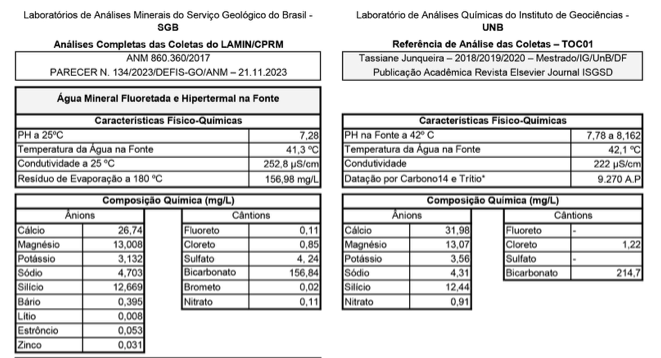
Brazilian water legislation, for the purpose of bottling mineral water, imposes the obligation of water collection for testing during each season of the year. Thus, in relation to the Well/Spring Hanuman I, mining process ANM 860.360/2017, the Mineral Analysis Laboratory (LAMIN) of the Mineral Research and Resources Company (CPRM), a governmental company linked to the Ministry of Mines and Energy, and a service provider to the ANM, conducted four water collections in 2023, one in each season.

The results of these collections allowed the ANM to issue the Dispatch n. 134/2023 and n. 78/2025, through which the water from the Well/Spring Hanuman I was officially declared “fit for bottling and human ingestion,” also obtaining the bottling label with the classification of “Fluoridated Hyperthermal Mineral Water at the Source.”

This classification and label follow the norms of the Brazilian Mineral Water Code of 1945 – a legal framework outdated in the face of advancements in hydrogeochemical science. Thus, functional elements, in natural and stable concentrations, such as barium, silicon, lithium, strontium, zinc, among others, which are present in the water from the Well/Spring Hanuman I, are not declared on the official labeling.

Analyses by the Geochemistry Laboratory of the University of Brasília – IG-UnB

Research guided by the Geosciences Institute of the University of Brasília (IG-UnB) conducted seven water collections at the Hanuman Water Deposit between 2018 and 2019, where samples, for ten minerals, were analyzed at the Geochemistry Laboratory of UnB. The tritium analysis was performed by the Center for Nuclear Technology Development – CDTN (Belo Horizonte – MG), part of the National Nuclear Energy Commission (CNEN), linked to the Ministry of Science, Technology and Innovation (MCTI). The radiocarbon dating analysis (Carbon-14) was carried out by Beta Lab (Miami – FL-USA).

Tritium

Tritium, a radioactive isotope of hydrogen, became part of the global hydrological cycle after nuclear tests, accidents like Chernobyl and Fukushima, and civil and military nuclear activities.

When it binds to the water molecule (H₂O), it forms what is called tritiated water (HTO), which circulates like any other: it evaporates, condenses, rains, infiltrates, and runs off. For this reason, tritium is now considered a global marker of the radioactivity of the nuclear age, which began in 1945.

Just like microplastics, heavy metals, and some pesticides, tritium is present in almost all waters on the planet, in higher or lower concentrations, depending on the region.

In 2023, researchers from Hirosaki University in Japan detected tritium in 41 brands of mineral water sold in 23 countries in the Northern Hemisphere, confirming a growing suspicion: even “pure” mineral waters can carry traces of the nuclear age.

The unique geology of Chapada dos Veadeiros, combined with the depth and age of the Water Deposit, preserved Hanuman Water completely free of tritium — a geological rarity and a symbol of purity predating the industrial and radioactive contamination of the Earth.

MULTIMILLENNIAL

The Water that emerged from Time

The water from the Hanuman Water Deposit and Well/Spring Hanuman I is of incomparable purity and quality, originating from rainfall that occurred more than 9,000 years ago in the area that is now the Chapada dos Veadeiros National Park, declared a UNESCO World Heritage Natural Site.

Over millennia, this water infiltrated through deep geological faults and fractures formed nearly 2 billion years ago, traveling hundreds of kilometers underground and crossing diverse layers of piezoelectric minerals, such as quartz crystals, amethyst, and beryl, until emerging in the Hanuman Water Deposit at 42°C with a pH between 7.2 and 8.16.

As a liquid testament to time, the waters from the Hanuman Water Deposit and Well/Spring Hanuman I carry the geological history of Chapada dos Veadeiros in their essence. Studies conducted by the Brazilian Geological Survey and the University of Brasília reveal a unique and exclusive water narrative on the planet. For this reason, these waters soon earned the nickname “diluvian waters,” “diluvian thermal waters,” and “diluvian mineral waters” by association with the rains from the floods recounted in the Sumerian epics Gilgamesh and Atrahasis, as well as in the Greek, Norse, Amerindian myths, and other ancient civilizations around the world. Not to forget, of course, the flood announced to Noah and the survival in the Ark, as described in the Bible.

Given these nicknames and the results from hydrochemical analyses of samples conducted by LAMIN/CPRM/SGB, as well as academic studies and publications by the IG-UnB, the marketing department of Hanuman Minas Ltda commercially classifies Hanuman Water as:
“Diluvian Mineral Water*, Hyperthermal, Alkaline Mineral Water, Magnesium, Fluoridated, Chlorinated, Barium-rich, Lithium-rich, Zinc-rich, Calcium-rich, Sulfated, Silicated, Sodium-rich, Potassium-rich, Strontium-rich, Bicarbonated and Hyperthermal at the Source + 21 trace elements.”

These waters establish a bridge between the geological past and the present, offering not just hydration but a tangible connection to Earth’s natural cycles. Their discovery represents a scientific milestone, revealing a preserved aquifer that defies time.

The multimillennial hyperthermal multifunctional mineral water from the Hanuman Water Deposit, untouched and rich with a balanced essence, flowing continuously since the dawn of human civilization, is a gift from Mother Earth for multigenerational benefit.

HYPERTHERMAL

The Heat That Regenerates

Brazilian Water Code Classification of Thermal Springs

Article 36, paragraph 2 (Decree-Law No. 7,841/1945), classifies water springs based on temperature according to the following scale:

I. Cold springs, with temperatures below 25ºC (77ºF)

II. Hypothermal springs, with temperatures between 25 and 33ºC (77 ºF – 91.4 ºF)

III. Mesothermal springs, with temperatures between 33 and 36ºC (91.4 ºF – 96.8 ºF)

IV. Isothermal springs, with temperatures between 36 and 38ºC (96.8 ºF – 100.4 ºF)

V. Hyperthermal springs, with temperatures above 38ºC (above 100.4 ºF)

Hanuman emerges at 42°C ( 107.6 ºF ) a temperature that enhances its mineralizing action and invites us to:

Reconnect

with the Earth’s geothermal pulse

Revitalize

the body through natural thermotherapy

Experience

the original thermal balance

The Hanuman Water Deposit Project goes further.

MULTIFUNCTIONAL

Geodiversity at the Service of Sustainable Development

The Hanuman Water Deposit Project goes further. Over more than a decade of studies and formalized requests submitted to the ANM, a true hydrothermal corridor has been structured under the technical, legal, and territorial domain of the entrepreneurial group.

The areas currently under research authorization total over 2,000 hectares across the municipalities of Niquelândia, Colinas do Sul, and Alto Paraíso de Goiás, encompassing the three hydrochemical groups of emerging waters along the São Joaquim Geological Fault. This mapped set forms a multigenerational geothermal bank with potential for sustainable industrial, therapeutic, scientific, and tourist developments over the coming decades.

Hanuman Minas Ltda

Mineral Multimillennial Hyperthermal Multifunctional – Tritium-Free
Chapada dos Veadeiros · Central Brazil

contact@hanumanwater.com
Niquelândia – Goiás – Brazil

Social